
Meet the Finalists of the 2025 ISSNAF Young Investigator INFN Bruno Touschek Award
Updated: Oct 13, 2025
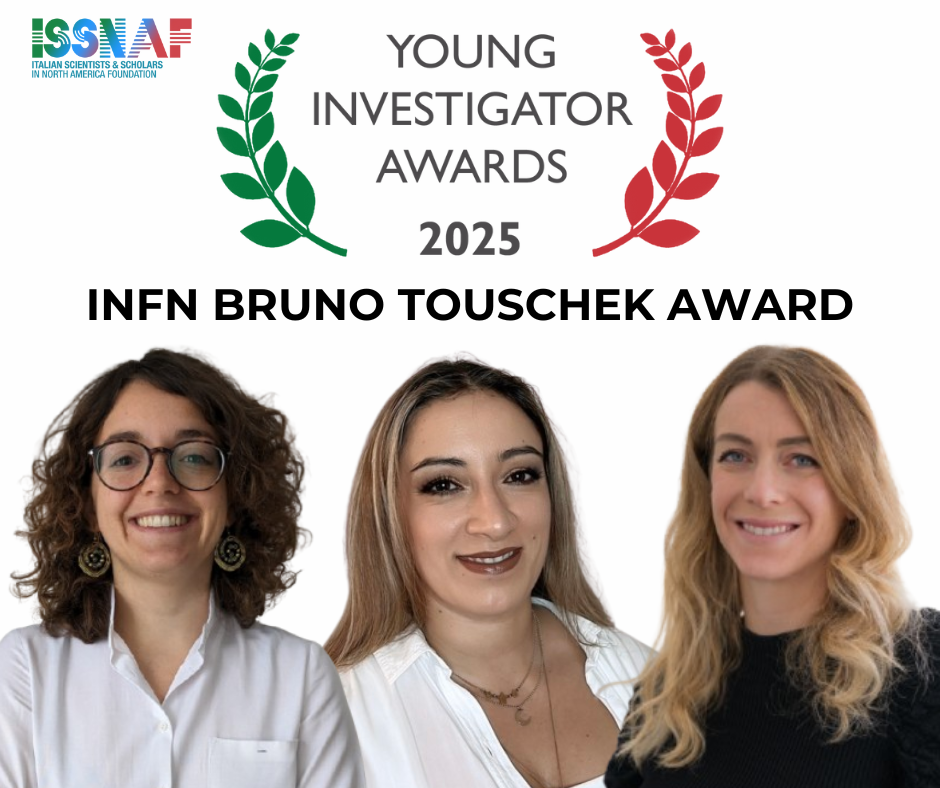
Established in 2022 by Istituto Nazionale di Fisica Nucleare, this award honors the memory of Prof. Bruno Touschek for his pioneering work in the fields of elementary particle physics and particle accelerators. It recognizes contributions in the fields of fundamental interactions of matter, such as elementary particle physics, nuclear physics, cosmology and the physics of particle beams.
We extend our warmest congratulations to the exceptional finalists of the 2024 edition:
Francesca Bonaiti
Giulia Cerini
Antonella Palmese
Discover more about the three finalists and their research, which they will present to the jury chaired by Dr. Patrizia Rossi (Jefferson Lab), and including Prof. Orlando (Università di Trieste) and Dr. Ratti (Berkeley Lab).
The winner will be announced during the ISSNAF 2025 Annual Event in Washington, D.C., on November 6.
FRANCESCA BONAITI

Francesca is a theoretical nuclear physicist who studies how protons and neutrons interact to form atomic nuclei and how these systems relate to some of the most extreme environments in the cosmos, such as neutron stars. Originally from Villa di Serio, a small town near Bergamo, she earned her Bachelor and Master degrees in Physics from the University of Trento, where her passion for nuclear theory first blossomed. She then moved to Germany to pursue her PhD at Johannes-Gutenberg University Mainz, where she obtained it in July 2024. During her doctoral studies, Francesca visited Oak Ridge National Laboratory (ORNL) in Tennessee twice, an experience that inspired her to continue her research career in the United States. She is now a Theory Fellow of the Facility for Rare Isotope Beams (FRIB) at Michigan State University, hosted by ORNL. This is a prestigious five-year position that supports independent research in low-energy nuclear physics. In her work, she combines theoretical modeling with high-performance computing to explore the properties of atomic nuclei and their connection to the Universe’s most fascinating phenomena.
Research Focus
Francesca’s research focuses on understanding the structure and dynamics of atomic nuclei and their role in extreme astrophysical environments, such as those found in neutron stars, among the most fascinating objects in the Universe. These stars are incredibly dense and compact remnants formed from the collapse of massive stars in supernova explosions. What holds them up against their own gravity is the pressure of nuclear matter, described by the nuclear equation of state, which determines how matter behaves at extreme densities. Understanding the equation of state is a major challenge in modern physics, requiring input from theory, experiment, and astronomical observations. Francesca studies the region inside neutron stars where matter reaches the typical density of atomic nuclei. Using advanced computational tools and mathematical methods, she predicts nuclear properties that are closely connected to the nuclear equation of state, linking laboratory measurements to the exotic conditions inside neutron stars. By improving our understanding of nuclear matter under these extreme conditions, Francesca’s research helps to answer fundamental questions about the composition, structure, and behavior of neutron stars, as well as the origin of the elements that make up the Universe.
About Her
The passion for science and discovery led Francesca from Italy to Germany and then to the United States, where she enjoys living and working with people from diverse backgrounds. Beyond research, she has been involved in science outreach on Italian YouTube channels and she has served as a PhD student representative, organizing scientific events and creating networking opportunities for early-career researchers. In her free time, she loves running, hiking, going to the theater, and listening to live jazz music in the bars of East Tennessee.
GIULIA CERINI

Giulia Cerini was born in Rieti, Lazio, Italy, where she attended Liceo Classico M.T. Varrone. She earned a degree in Physics and a master’s in Astronomy and Astrophysics at La Sapienza University of Rome, focusing on supermassive black holes. She then moved to the United States, earning a second master’s in Physics and a Ph.D. at the University of Miami, where she worked on galaxy clusters and the large-scale structure of the Universe through X-ray analysis. More recently, she expanded into weak gravitational lensing and cosmology, developing multi-wavelength methods for galaxy cluster studies. She is also part of the Super-pressure Balloon-borne Imaging Telescope (SuperBIT) collaboration, an international high-altitude balloon project mapping dark matter through lensing.
Already as a Ph.D. student, she published in high-impact journals, delivered invited and contributed talks at leading conferences, and was awarded two competitive NASA grants as Science PI: a Chandra Program and a NASA Astrophysics Data Analysis Program (ADAP) award. She then won the NASA Postdoctoral Fellowship, and thanks to the combination of independent funding and fellowship support, she established her position at NASA’s Jet Propulsion Laboratory (JPL), California Institute of Technology, where she now continues as JPL Postdoctoral Researcher.
Research Focus
Giulia Cerini’s research uses galaxy clusters—the most massive gravitationally bound systems in the Universe and natural cosmic particle colliders—as laboratories to investigate two of the greatest challenges in modern cosmology: the nature of dark matter and the origin of tensions in the measured values of cosmological parameters that describe the fundamental properties, structure, and evolution of the Universe. She developed a novel multi-component analysis that quantifies the spatial correlation between dark matter, inferred through gravitational lensing, and baryonic matter distributions, namely hot X-ray–emitting gas and galaxies. She originally designed this approach to improve cosmological parameter constraints by correcting for assumptions about the cluster’s dynamical state, which strongly affect cosmological inference. She has since extended it to probe the fundamental nature of dark matter itself, searching for observational signatures of possible particle interactions. Perfectly timed for the current golden era of cosmology-oriented wide-field lensing missions such as Euclid, Roman, and Rubin, and X-ray surveys like eROSITA, she is uniquely positioned to transform thousands of observed clusters into precision tools for cosmology and dark matter physics.
About Her
From a very young age, Giulia Cerini nurtured a deep passion for the Universe, with the lifelong dream of working at NASA and one day going to space. This aspiration has guided her academic and professional journey in astrophysics and cosmology. At the same time, she dedicated herself to sports, especially martial arts, becoming a Kung Fu instructor and successful competitor. As both a martial artist and track-and-field athlete, she earned 40 medals and trophies at regional, national, and international levels. Today, she channels the same discipline and determination through CrossFit, balancing her scientific career with athletic resilience.
ANTONELLA PALMESE

Antonella is an observational cosmologist working at the interface between gravitational wave experiments and large sky surveys. She is currently an Assistant Professor in the Physics Department at Carnegie Mellon University, in Pittsburgh (Pennsylvania), where her group's research is funded by NASA and the US National Science Foundation. In 2021 she was awarded the NASA Einstein Fellowship, which she brought to the University of California Berkeley, where she worked under the supervision of Nobel Laureate Prof. Saul Perlmutter. Before that, she was a Postdoctoral Research Associate in the Cosmic Physics Center group at the Fermi National Accelerator Laboratory in Illinois, and an Affiliate Fellow at the University of Chicago. She completed her PhD in 2018 at the University College London under the supervision of Prof. Ofer Lahav, and obtained both the Bachelor and Master degrees at La Sapienza University of Rome.
Research Focus
Antonella's research focuses on cosmological measurements of the content and expansion of the Universe through multimessenger approaches. I take advantage of observations from different “messengers’’, namely gravitational waves and light, which carry different, complementary information about their source and the spacetime between the source and Earth. Gravitational waves are ripples of spacetime which we can currently detect when they arise from the merger between two of the most compact objects in the Universe: black holes and neutron stars. In some cases, light (the “electromagnetic counterpart”) from these cosmic collisions can be observed with telescopes. For other events, we can only observe the electromagnetic radiation from the likely host galaxies of these events. In either case, we can combine electromagnetic and gravitational wave data to constrain the expansion rate of the Universe, especially its value in the nearby Universe (the “Hubble constant”), through the “standard siren” method. My main goal is to use standard sirens to shed light on one of the most debated problems in modern cosmology, the “Hubble tension”, arising from a discrepancy between two major cosmological probes, by providing an independent measurement of the Hubble constant from gravitational waves.
About Her
Outside of work, I love to play beach volleyball at a competitive level, and train in Crossfit and Olympic Weightlifting. I also enjoy live music and theaters, and I love to scuba dive when I am close to a beautiful sea.


Comments